From a Bold Idea to a National Initiative
Early after her appointment as CEO of 42 in 2018, Sophie Viger started wondering: could the collaborative, gamified and self-directed learning model with which 42 had produced exceptional software engineers also work for children just beginning their digital journey? In a world that was becoming increasingly dominated by tech, could 42 do more to equip future generations? It was with these questions in mind that IOTA first saw the light of day in 2020.
Shortly after, in 2021, IOTA entered classrooms in a handful of schools, in partnership with the . These were soon joined by more, and by the 2023–2024 academic year, over 100 CM1 and CM2 (4th and 5th grade) classes across France had taken part. The results of that study are available on IOTA’s website. Since then, IOTA has grown from a pilot project to a national platform, freely accessible to every school within the French public education system.
The Platform: Reach for the Star!
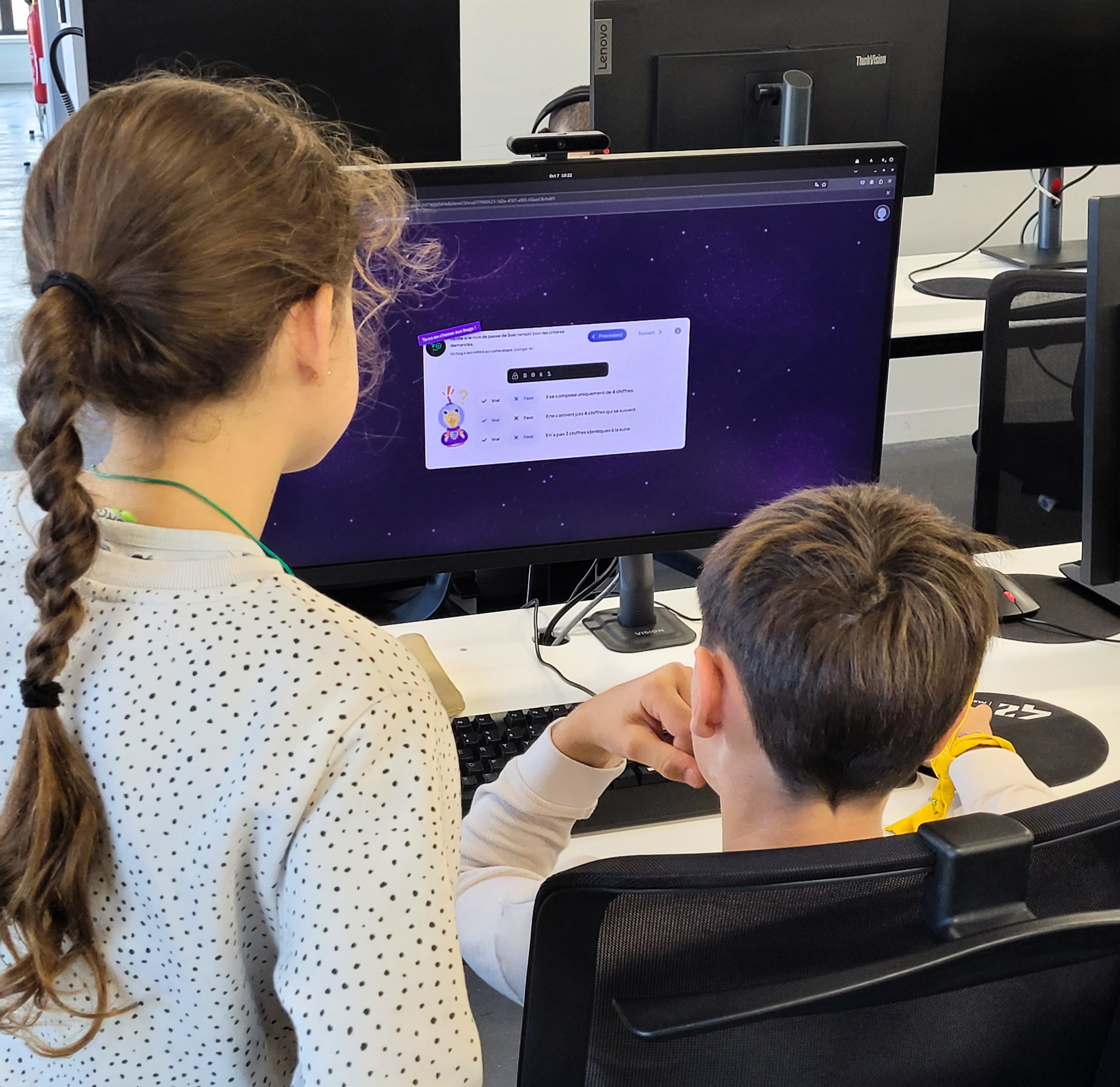
At first glance, IOTA looks like a game. And in many ways, it is. Pupils are immersed in a narrative universe: Aboard their spaceship, the astronauts must obtain their galactic visa in order to travel to the different planets and reach the IOTA star. Structured around four planetary systems, the platform invites pupils to complete missions, earn badges, rise through the ranks, and unlock new levels! A full gamification logic that keeps engagement high and reinforces cohesion within the classroom.
But behind the adventure lies a rigorous pedagogical framework. The activities on IOTA cover 100% of the CRCN (France’s national Digital Skills Reference Framework), addressing topics as varied as: digital citizenship and online safety, algorithmic thinking and introductory programming, content creation, cyberbullying awareness, as well as an introduction to AI.
Sessions run for roughly 45 minutes per week, totalling approximately 28 hours of structured digital learning over a school year. Regarding the equipment needed, the bar was deliberately set low: one only needs computers or tablets for the whole classroom and a working internet connection.
The Pedagogy: Learning By Doing, Together
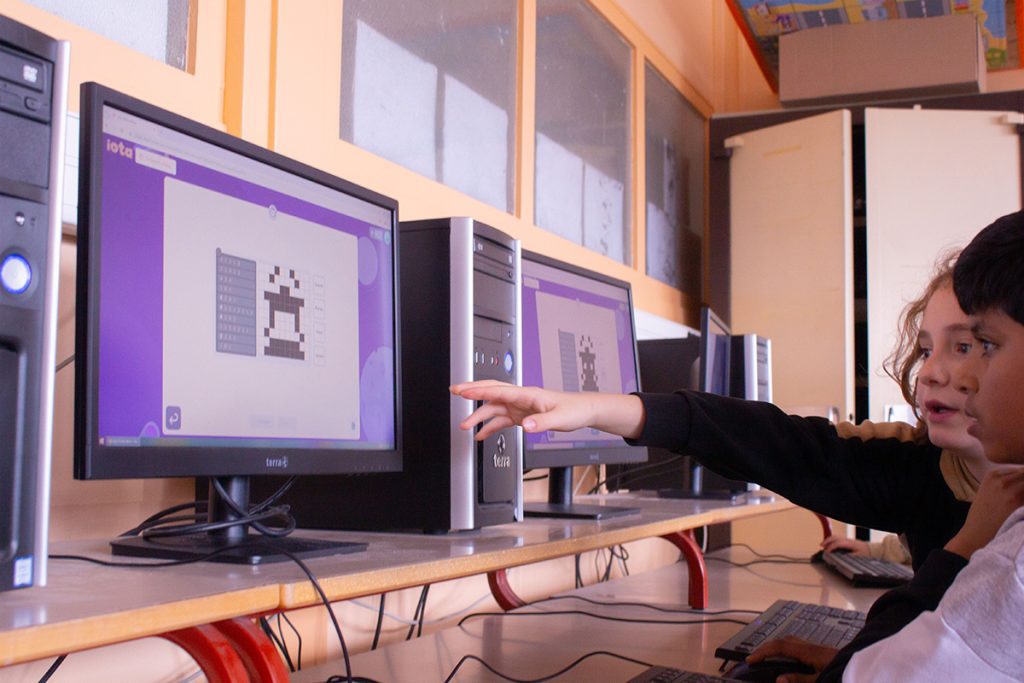
What truly sets IOTA apart is not what it teaches, but how it teaches. The platform is built entirely around 42’s founding principle of peer learning: the idea that pupils learn best not from passive instruction, but from active collaboration with their classmates. When a student needs help, they don’t raise their hand and wait for the teacher. They request support through the platform, which randomly assigns a peer to assist them. When an activity needs to be corrected, it is the pupils themselves who evaluate each other’s work (“bug hunts”). Group projects are assembled algorithmically, ensuring that children work with peers they might not naturally gravitate towards, crossing lines of gender, background, and academic level.
This design is intentional and consequential. By removing the social biases that typically govern who collaborates with whom, IOTA creates a classroom dynamic that is genuinely inclusive. Pupils with learning difficulties benefit from audio reading of content and typography adapted for those with dyslexia. Pupils who might otherwise disengage find themselves drawn in by the game mechanics and the social accountability of being someone else’s helper.
Teachers, for their part, take on a different role: not the source of all answers, but a guide in a classroom that is self-organising. There is no answer key in IOTA. The point is the process of finding solutions, as well as the ability to think critically, iterate, and learn from mistakes.
The Evidence: More Than a Digital Skill
In the 2023–2024 school year, a rigorous scientific impact evaluation was conducted by education economists Camille Terrier and Fanny Landaud. Working with 2,371 pupils across 109 classes, in which half served as “test” classes using IOTA and the other half were the control group, they observed the following things:
- Cross-gender friendships increased by 19%, with cross-social-background friendships rising by 9%
- Physical bullying fell by 33%, and by 45% among pupils from disadvantaged backgrounds
- Psychological bullying dropped by 31%, with a 40% reduction for vulnerable pupils
- Girls’ confidence in their own ability to code increased by 22%, narrowing the gender gap in digital self-efficacy
As researchers Terrier and Landaud put it: “IOTA proves that well-designed EdTech can reduce inequalities.” On our end, we like to believe that IOTA equips pupils not only with what it takes to become a good programmer, but also a good colleague, a good collaborator and a good citizen.
What Comes Next
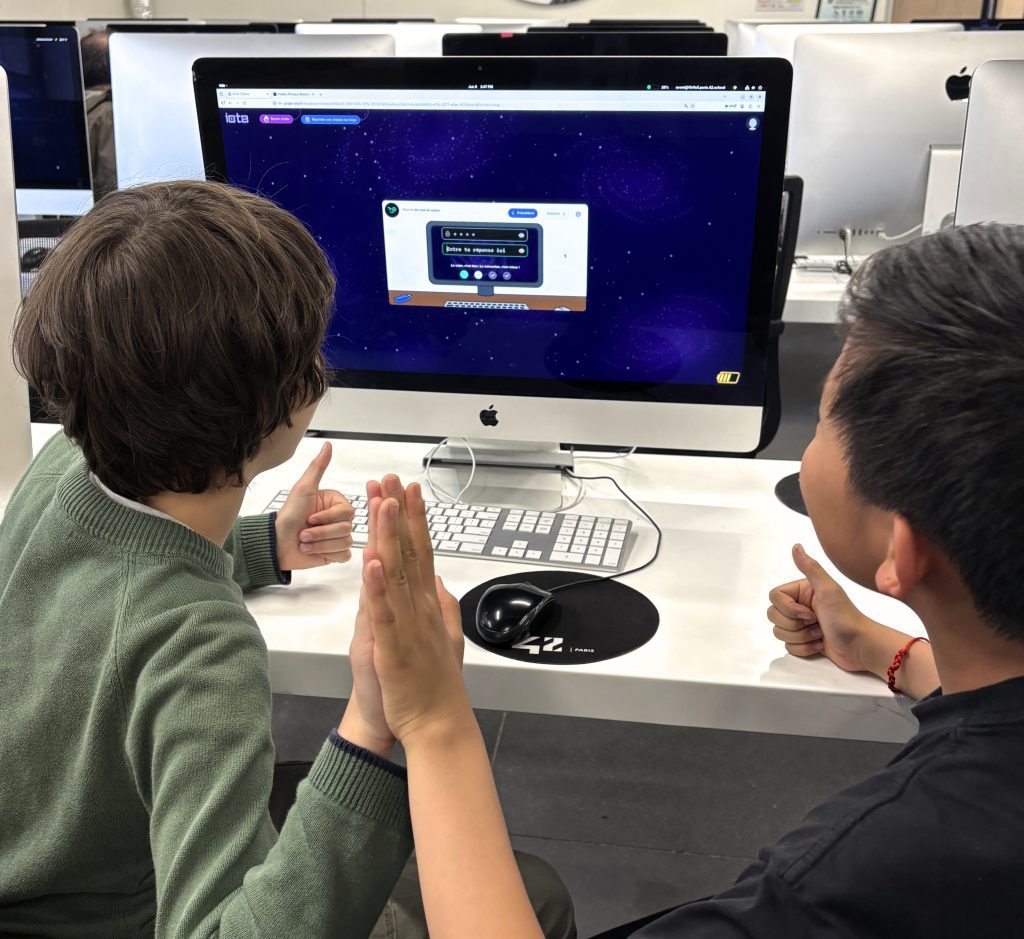
The IOTA Project is not standing idle either. From the 2025–2026 academic year onwards, the platform offers two distinct learning pathways year 1 and year 2, for pupils between. This will enable schools to deploy IOTA across two consecutive years and deepen the learning journey.
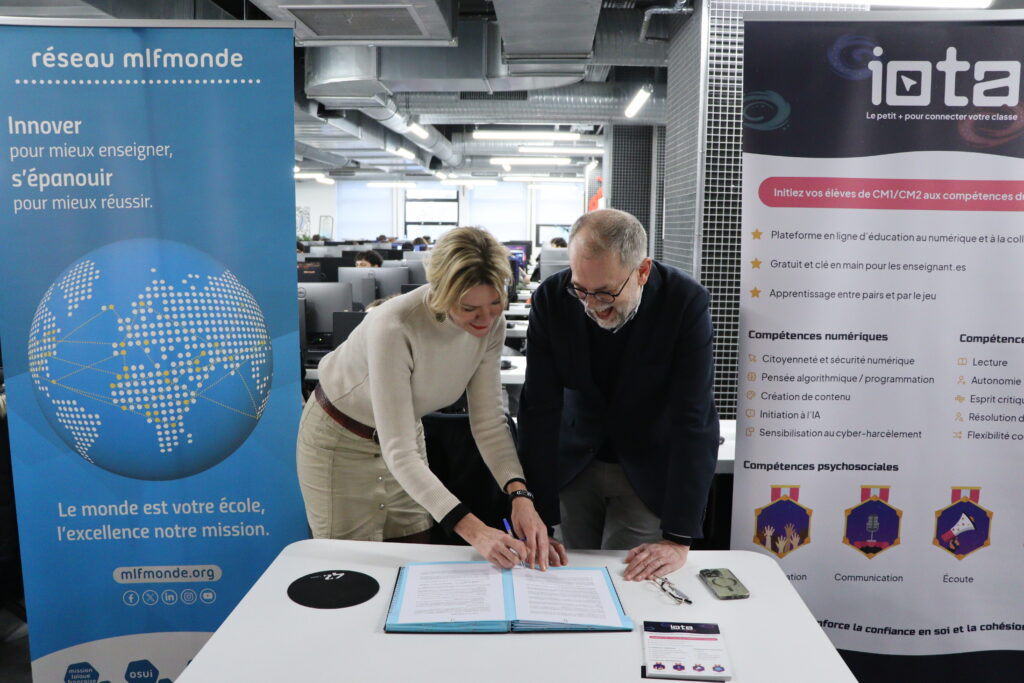
Distribution is also expanding. Early in 2026, IOTA was officially referenced in Belgium, on Wallonia’s e-class platform for pedagogical resources. It is also currently in use in 20 Mission Laïque Française (MLF) and Agence pour l’Enseignement Français à l’Etranger (AEFE) classes in Ivory Coast, Bahrein, Italy, Morocco, Lebanon, Sweden, the USA, Madagascar and Mauritania. Furthermore, pilot testing is currently underway in several countries, including in Jordan (where the program will be tested this summer with 10,000 pupils), the UAE and Guinea. Furthermore, the project is being studied in Brasil and Luxembourg.
The ambition, as IOTA’s team articulates it plainly, is to equip tomorrow’s citizens with both digital skills and the relational capacities that collaboration demands.
For more information, visit projet-iota.fr.