Five Top AI/Tech CEOs saying the exact same thing.
Early in 2025, when asked about the advice he’d give current students looking to enter the world of tech, Sam Altman, CEO of OpenAI, stated: “the valuable thingI learned in school is the meta ability to learn, not any specific thing I learned.” Later in that same interview, he went on to say that he believed that, in a world where whatever was trendy today would not stay that way for long, resilience and adaptability would be qualities that would stand the test of time.
Later that year, his words were echoed by those of Demis Hassabis, Google’s top AI scientist (CEO of Google Deepmind) and 2024 nobel prize in chemistry. Speaking at an event in Athens, Greece, about the future of AI, he stressed that rapid technological change would make the ability to keep learning increasingly important: “One thing we’ll know for sure is you’re going to have to continually learn … throughout your career.”

Reid Hoffman, co-founder of LinkedIn, echoed similar views, making a point that could almost have appeared in a 42 brochure. Addressing students concerned about the value of their degrees in an AI-driven job market, he argued that what matters most is not a fixed set of courses or skills, but the ability to keep learning and adapt to new tools and challenges: “It’s your capacity to learn. It’s your capacity to say, ‘Hey, here is the new tool set, here’s the new challenge.’”
More recently, AWS CEO Matt Garman put the point more bluntly. Speaking at the HumanX conference in San Francisco in April 2026, he stressed that workers could no longer expect the skills they acquire today to carry them through an entire career. “Maybe the best skill that you can learn is learn to learn… Don’t assume that whatever you learned is now good for the next 40 years.”
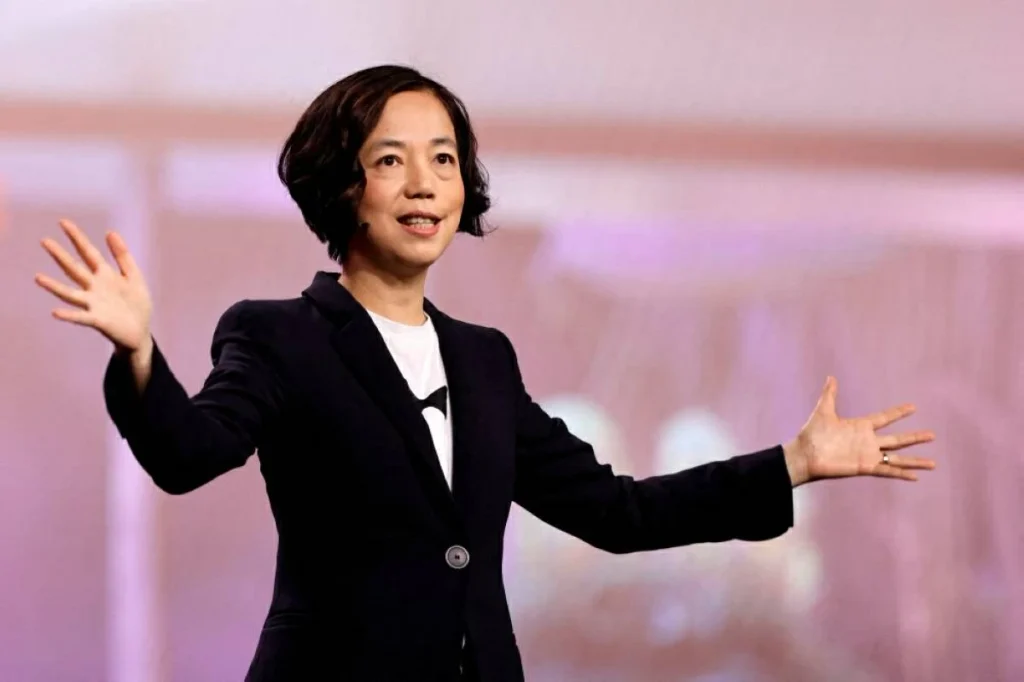
Lastly, Dr. Fei-Fei Li, CEO of World Labs and a professor at Stanford University offered a similar perspective. Often referred to as “the Godmother of AI,” Li argued in a December 2025 interview on The Tim Ferriss Show, she stated that, as technology evolves, the ability to keep learning matters more than relying on a fixed set of credentials or skills. As she put it:“the timeless value of learning to learn, the ability to learn is even more important now.”
42 was right all along.
Five people at the center of Tech and the AI industry, no coordination between them, all saying the same thing: your value in tomorrow’s tech market resides in your capacity to keep learning once what you know becomes obsolete.
For most of the tech world, that’s a lesson AI forced on them over the last couple of years. For 42, it’s simply proof the original bet held up. 42 students aren’t waiting for someone to hand them an AI curriculum before they go build something with it. Across the network, students have been taking on AI-related hackathons and challenges, and winning them.
At 42 Prague for example, four students built an AI-powered educational tool called Eduvhled Engine and won DigiEduHack 2025, organized by the European Commission, beating out 800 projects from 31 countries. At 42 Roma, three students had 15 hours to build something at Codemotion Big Hack 2025. They shipped Summy, an AI tool that turns dense content into clean executive summaries, and took first place.
At 42 Berlin, a single student, Thanakorn Thajan, built a full-stack AI platform that decides in real time whether to pull power from solar, battery, or the grid, earning second place at the Berlin Energy Hackathon. 42 Wolfsburg’s team TALEMT won the KI Hackathon with an AI system for streamlining document processing in immigration offices. And at 42 Abu Dhabi, student team NoTime placed first at BNB Hack with an AI agent built for blockchain access and DeFi.
None of these students were handed a syllabus for “how to win an AI hackathon.” They picked up tools that didn’t exist a year or two earlier and figured it out on the spot, alongside with their team, which is exactly the muscle the 42 model is built to train.
That same principle is now being taken further in the curriculum itself. . As of this year, AI is no longer uniquely in the Advanced Core at 42, it’s built into the Common Core. 42 made the choice to bring these tools directly into the core learning experience, while preserving the model behind it: learning by doing, adapting, experimenting and solving problems.
And 42 Alumni are already working inside some of the companies shaping this technological shift, including . OpenAI, NVIDIA, Google, AWS, Apple, and Mistral AI.
As CEO Sophie Viger puts it: 42 was never really a coding school. It’s a school where you learn to face the unknown. That is worth saying plainly, to students wondering if the model still holds up in an AI world, and to partners wondering if 42 students are ready for what’s coming.
They are. They always were.