Could you briefly introduce yourself?
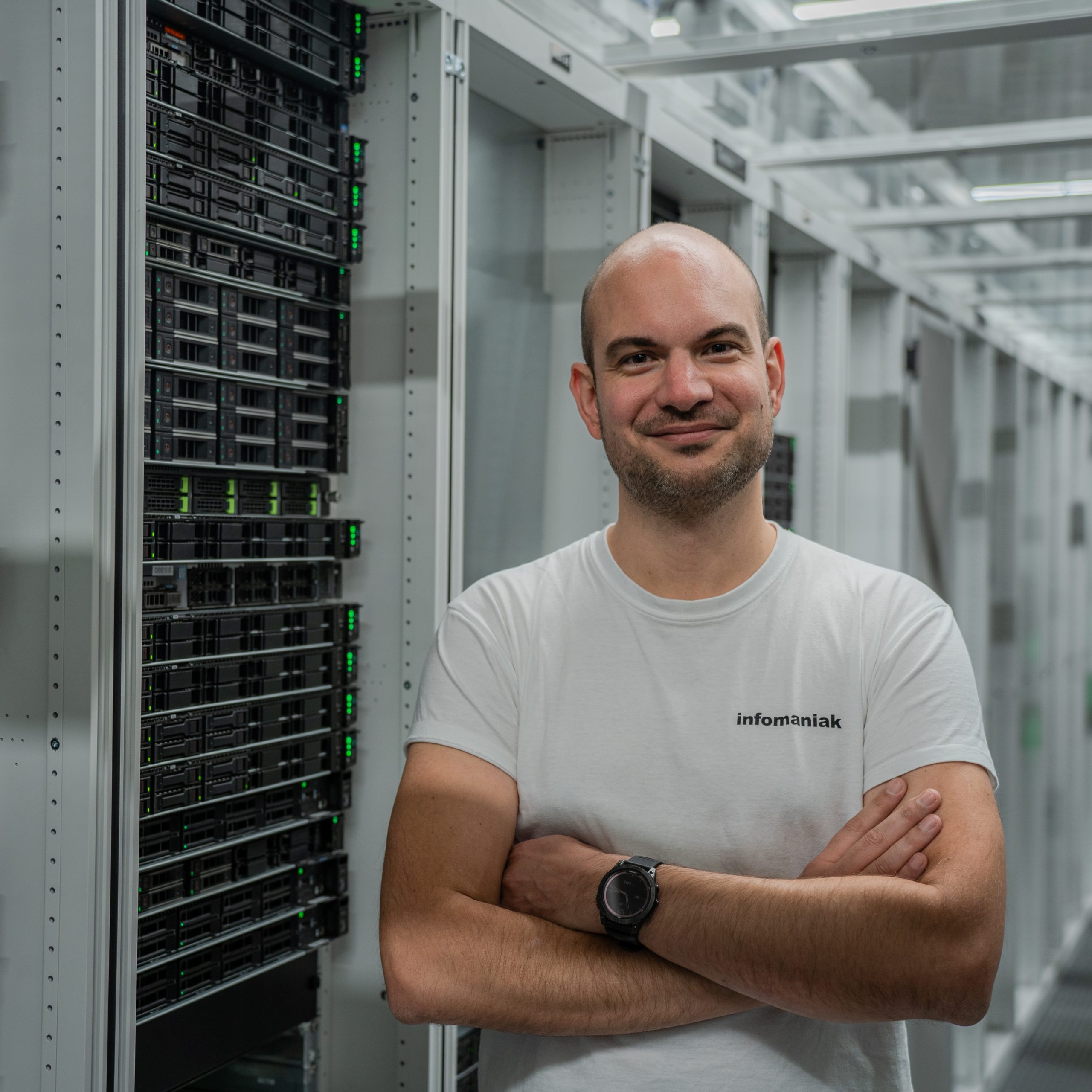
I’m Thomas Jacobsen, and I’ve been working at Infomaniak since 2015, handling communications and marketing. I also serve as the company’s spokesperson externally. Prior to that, I worked in public administrations in the canton of Vaud. I’ve always been passionate about technology; I taught computer courses during my studies in international relations and then in management and public policy.
Can you tell us more about your company and your role?
Many people use our services without necessarily knowing our company: Infomaniak is the company behind SwissTransfer.com or Euria, a sovereign AI. The company was founded in 1994 in Geneva by Boris Siegenthaler, who still works as its strategic director to this day. The company was established following his vision and conviction: that digital must be respectful of people, their data, and the environment. Thirty years later, that vision still guides every decision we make.
This means we’ve chosen to control everything from within Europe. We design, develop, and operate our services in our own data centers in Switzerland, with all of our staff based in Geneva and Zurich. Data is strictly governed by Swiss law, in full compliance with GDPR. 100% of our energy is renewable. Our most recent data center fully repurposes its heat to warm thousands of homes. We source our components from Europe whenever possible, even when it costs twice as much.
Today, with AI (to which we entrust an enormous amount of personal and professional data) this approach makes even more sense. Businesses and individuals need to know where their data goes and who controls it. That’s exactly the answer we’re building, and millions of users across Europe already trust us.
For me, it’s an immense pleasure and privilege to champion the vision of a more ethical digital world every day, and to see that what we’ve always stood for has become an issue no one can ignore anymore.

How did you discover 42?
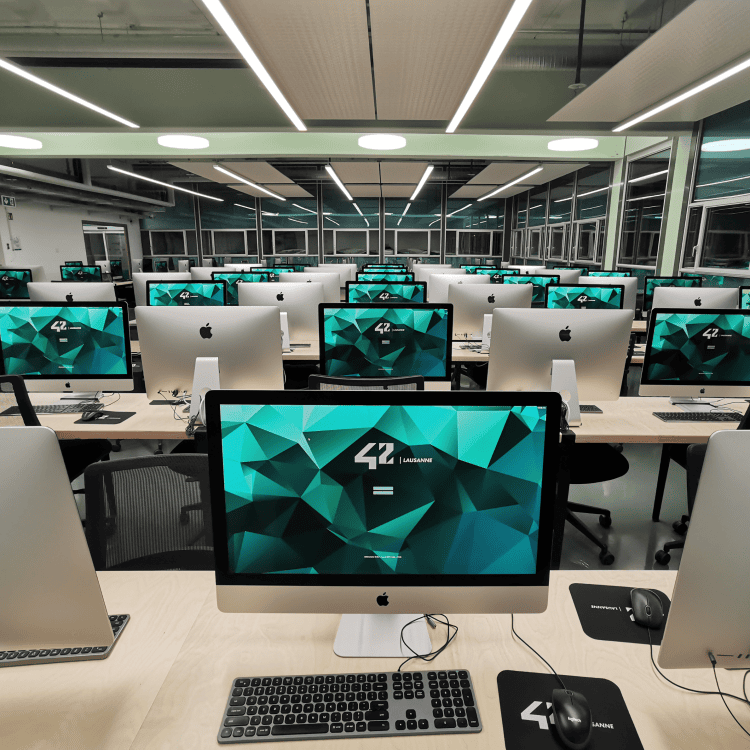
Christophe Wagnière reached out to us. I remember our first video call very well: he was under a roof in the middle of summer, in sweltering heat. 42 Lausanne didn’t exist yet, but you could tell it already existed in his mind. What immediately caught my attention was that we shared the same observation: there’s a real need to train developers in open technologies, to address the concrete needs of companies looking for operational skills, not just theoretical or highly specialized ones. The project resonated with us right away.
What motivated you to support the campus?
It’s an alignment of vision on several levels. First, there’s the shortage of developers with the skills our industry needs. Then there’s the fact that the school is free, making it accessible to everyone. This resonates deeply with us, because at Infomaniak, many of our exceptional people are self-taught enthusiasts. There’s also the commitment to making coding more accessible to women: the current imbalance in our industry is really significant, and 42 is doing meaningful work on that front. And then there are shared values on a fundamental level: training people in open technologies rather than closed ecosystems that make deployments so easy you end up losing control entirely and becoming fully dependent on hyperscalers like Microsoft, Google, or Amazon. Preserving and developing local expertise is essential to us.
What sets 42 apart, according to you?
What’s truly interesting about 42 students is that they’re very resourceful. They observe, they search, they find information on their own. They’re autonomous self-learners, and in our field, that’s exactly what we need, because everything evolves constantly, even more so with AI. The teacher-free pedagogy forces them to solve problems together, to challenge each other, to find solutions. And the fact that there are no diploma requirements opens the door to atypical profiles who, in the traditional system, might never have had their chance, even though some of them have enormous potential. This is exactly our philosophy at Infomaniak when we recruit: we look for passionate people who love to learn, work as a team, and find solutions.
What are your hopes for 42 Lausanne?
The collaboration is already very tangible today: there are hackathons and full projects with our teams running on our cloud and AI infrastructure, and we have many internship spots open to 42 students. Because in reality, the more students graduate with training in these technologies, the quicker they are fit to work in companies like ours, and the more we collectively strengthen an independent European tech sector.
And for the future of education?
My hope is that we keep valuing the capacity to learn rather than the diploma on the wall. The world is moving too fast for rigid five-year programs to be sufficient. What we need are curious people, capable of adapting, who know how to find a solution when there is no obvious one. That’s exactly what 42 encourages. I also hope that education will integrate the issues of technological sovereignty even more deeply, understanding what we’re building on, what we control, who can access what, and what we’re delegating and to whom. These are strategic issues for an entire generation.
A final word to conclude our interview?
42 Lausanne is proof that we can train people differently, for free and without diploma barriers. It’s a source of pride for us to be part of it. And beyond all this technology, there are warm human connections, passion, and joy. We must never forget that behind the cloud, there are people.