Embedded in the City’s Cultural Landscape
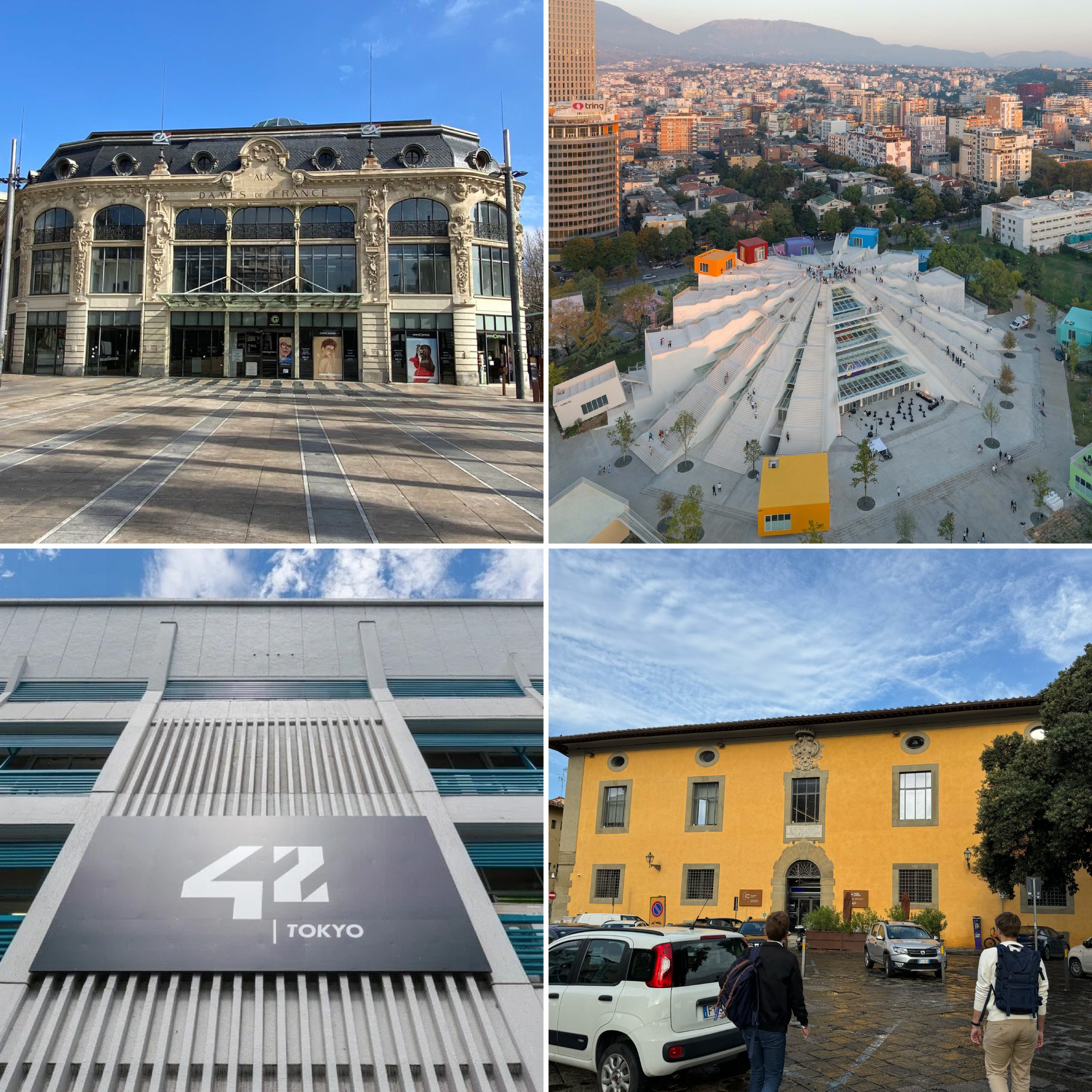
To start with, several of our campuses are located near or even sometimes within cultural landmarks of their cities. One of the best illustrations of this is 42 Tirana, which is located in the Pyramid of Tirana. Built in 1986–88 as a monument to communist dictator Enver Hoxha, the Pyramid of Tirana became a conference center after 1991 and a NATO base during the 1999 Kosovo War. After having been abandoned for some time, the building was renovated and reopened in 2023. It has become one of the city’s most iconic landmarks over the years.
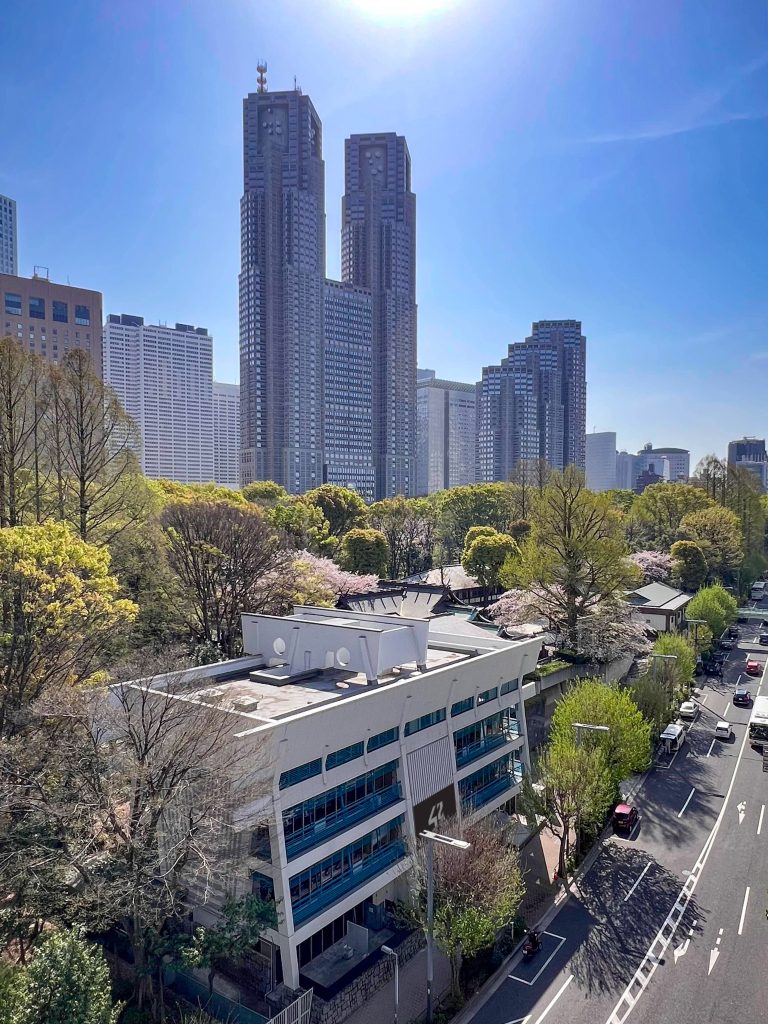
Similarly, and while it is not itself located in a landmark building, 42 Tokyo’s campus sits right across a park from the imposing Tokyo Metropolitan Government Building. One of the largest government buildings in the world, it was Tokyo’s highest building until 2007 (242m high), and was recently listed in the Guinness World Records as having the largest projection mapping display in the world. More interestingly, and perhaps surprisingly, the campus is also nestled against the Juniso Kumano Shrine, a Shinto sanctuary that was founded in the early 15th century. To this date, it is one of the oldest places of worship in the Japanese capital.
Architectural Wonders
Other 42 campuses are located in buildings that, if not as historically or culturally important to their cities, are nonetheless architectural masterpieces. This is notably the case of 42 Perpignan, which occupies the old flagship of Aux Dames de France, a former department-store chain that once rivaled the famous Galeries Lafayette. Built between 1905 and 1907 by architect Georges Debrie, the building was known for its large windows and metalwork, characteristic of French “Belle Époque” commercial architecture. Its “art nouveau” façade is considered as one of the most beautiful amongst 42 campuses.
No less impressive or beautiful is 42 Firenze’s Granaio dell’Abbondanza building. A typically Florentine building, its construction dates back to the 17th century, at the request of the affluent Medici family. A granary at first, it was later owned by the Italian military before being restored to its former glory and turned into a tech hub by Fundazione CR Firenze between 2017 and 2021. With its bright yellow outer structure and Medici emblems adorning its doors, it stands as a testament to the city’s architectural landscape in the early 18th century.

Last but not least, 42 Marseille and its Grand Central building. Originally the regional Postal & Telecoms headquarters, built between 1937 and 1938 by architect Auguste Bluysen, the building sat vacant after postal services moved out. It was recently renovated and reborn as “Grand Central,” and houses the newsroom of La Provence, Marseille’s historic newspaper, as well as ZeBox, a local accelerator.
Street Art “Museums”
42 campuses also set themselves apart in the way they decorate their interiors. This is notably the case of 42 Paris, which, in case you didn’t know, is also a permanent street art museum! In collaboration with Nicolas Laugero-Lasserre, one of France’s leading street art curators, 42 Paris unveiled Art 42, an exposition that spans across the campus’ 9000 square meters and displays roughly 150 works from about 50 major urban artists, including Banksy, JR, and Shepard Fairey. The campus even holds street-art-centred visits for visitors every other Tuesday night.
Likewise, although they are not museums, Morocco’s 1337 campuses are just as visually striking. The original Khouribga campus, built inside a converted phosphate-industry factory, has been described as “reminiscent of Silicon Valley, complete with… graffiti art on the walls.” Later campuses (1337 Ben Guérir, 1337 MED and 1337 Rabat) continue the tradition of creating inspiring learning environments. tapping into Morocco’s thriving street-art scene (festivals like Rabat’s Jidar or Casablanca’s Sbagha Bagha) to make the schools feel more like galleries than institutions.

Honorable Mentions
Tucked into Vila Madalena, one of São Paulo’s most bohemian, mural-covered neighborhoods, 42 São Paulo occupies a converted duplex redesigned by local firm Superlimão. The architects drew on science fiction, “The Hitchhiker’s Guide to the Galaxy” of course, but also Kubrick’s “2001: A Space Odyssey”, to shape the school’s colors and finishes. The result: a retro-futurist, residential-style duplex turned 24/7 campus, a few streets from the neighborhood’s open-air art scene.
In the Eastern part of France, 42 Mulhouse occupies a former train factory dating to 1896, once part of the SACM industrial complex. Now rebranded as KMØ, the site celebrates its heritage: the old production workshops have been restored as a tribute to Mulhouse’s industrial pioneers, with a fresco adding a contemporary touch to the lobby.
Last but not least, the Gulf’s first 42 campus, 42 Abu Dhabi, sits in the historic Mina Zayed warehouse district, a former working port. Mina Zayed has been steadily reinvented as a creative hub, with disused dockworkers’ warehouses turned into galleries, studios, and schools. Designed to eventually host 750 students, 42 Abu Dhabi became the first campus of its kind in the GCC. While its warehouse was once stacked with cargo, it is now stacked with talent!
Together, these campuses make one thing clear: at 42, we don’t do ordinary spaces. From Medici-era granaries to former dockers’ warehouses and early 20th century department stores, our campuses transform forgotten landmarks into vibrant places for learning, creativity, and innovation.